|
May 12th, the day before the
final ritual, began as an ordinary day on Madison Avenue, the
street in New York City where all the great advertising agencies
were located back then, and probably still are now. As I mentioned
before, my job was that of a copywriter, one of those people
in an advertising agency who sit around all day and think up
ways to make you buy some kind of soap that sounds different
from any other soap, but isn't; or think up ways to make you
buy something you don't need at all.
The best idea I ever had was frying an egg in a electric coffee
percolator. That came about because the research department discovered
that many American women make a pot of coffee for their husbands
in the morning, then leave the coffee heating in the electric
percolator all day so they can have a cup themselves now and
then. But by the time one o'clock or so came along, the coffee
in the hot percolator looked like liquid tar and tasted like
burnt rope. Then somebody had the brilliant idea of manufacturing
a special coffee that would hold up to the heat of an electric
percolator. This brainstorm (which would later be categorized
under the heading of "seemed like a good idea at the time)
was the progeny of executive named Bull Robot who grated on my
nerves like sandpaper.
Bull Robot pronounced his
name Bool Roe-beau because he said his great, great, great uncle
had been a French count in the court of Louis XIV or somebody,
but I had my doubts. Never had a name suited anybody better.
Bull Robot had the tact and delicacy of rutting bull. He was
square jawed and square headed. He walked like a robot. He looked
like a bookend. He had a crew cut and little beady eyes and pronounced
the word advertising, ED-vertizzing, in such a way that you wanted
to squeeze his cheeks together until his tongue popped out. In
Bull Robot's eyes, I was a hippie in ad-man's clothing, useful
only because I was able to come up with enough unusual ideas
to make him look creative. It was a love-hate relationship. (For
my part, you can drop the love).
What nobody told anybody was that the amazing new coffee that
was eventually developed was just a weak blend that hadn't been
roasted very much, so it didn't turn into muck quite as fast.
As a result the husband got a ho-hum cup of coffee in the morning,
and the wife got a ho-hum cup of coffee in the afternoon, and
nobody got a really good cup of coffee anytime at all.
Anyway, my job was to think up something dramatic to get the
television viewer's attention and demonstrate what an electric
percolator could do to coffee. And that was where the fried egg
came in. I was sitting at my desk about 10:30 in the morning
staring out the window feeling totally uninspired when Magic
Betty stuck her head in the door and said, "Don't forget
tonight". I hesitated. "I don't know," I said,
thinking about the dead man complaining in the apartment above
mine. "Cluck, cluck, cluck," said Betty, making a sound
like a chicken. And that did it. I put two and three together:
Chicken...Egg...Percolator. The crowning achievement of my advertising
career had just been hatched.
I went down to the company cafeteria and stole an egg from the
executive kitchen refrigerator and went to the employee's cafeteria
and emptied the coffee out of one of the electric percolators
into the water cooler drain. Only two people were in the room,
and they were engrossed in nose to nose gossip. Their eyes were
squinted down into vicious little slits, and for a moment I thought
I had caught one of them looking at me. I let the empty pot continue
to heat a bit and cracked in the egg. A cloud of steam erupted
from the pot, accompanied by a violent hissing and crackling.
The raw egg was being seared alive on the blazing hot dry aluminum.
The egg bubbled and squirmed and curled up in a fricasseed knot.
I was fascinated. I just stared at it. Then it started to turn
brown. Then darker. A thin wisp of black smoke curled up to the
ceiling followed by a thicker plume. "Look!" I said,
speaking the very words that would begin the very first commercial,
"The heat of an electric percolator can fry an egg in minutes!"
I could have been heard a mile away.
The two people at the table stared at me and stood up nervously.
The egg was on fire. A memo on the bulletin board above the percolator
began to curl at the edges and flicker. Then the smoke alarm
went off. "Short circuit!" I shouted, "Everybody
get out." I ran upstairs and got Betty. "Let's go have
a cup of coffee. I've got something neat to tell you. But we've
gotta go somewhere else. There's a fire in the company coffee
pot."
And so, on May the 12th, the final night before the final ritual
of The Spell of the Lemures, I had miraculously stumbled over
a chicken crossing the road and fell upon an idea that would
make millions for General Foods and Maxwell House Electraperk
Coffee and net me not one measly dime. I did however get the
afternoon off because most of the office was uninhabitable because
of the smell of the burnt egg; and I did eventually have the
pleasure of watching dozens of announcers in tv commercials make
fools of themselves frying eggs, and bacon, and grits, and God
knows what else in electric percolators and talking about how
good the coffee tasted even way in the middle of the afternoon.
Which it didn't.
Elizabeth arrived at my apartment at 11:00 PM. She was always
on time and didn't even own a clock. She said she had accidentally
swallowed the cuckoo off a cuckoo clock, and that's what did
it; and I believe her, even if she made it up. I always meant
to ask her why she had the cuckoo in her mouth, but I never remembered
to ask except when she was somewhere where I wasn't, or it was
in the middle of the night, or she was out of town or something.
And to this day I still don't know, and since she's gone, I guess
I never will. (And unless you know somebody adept in the Heimlich
maneuver, I would suggest buying a wristwatch.)
We sat on the couch and fidgeted and didn't say much of anything.
I guess we were mostly just thinking about things, the stone
and other things. Every five or ten minutes or so I would go
call the time service on the phone. We had everything laid out
on the table. Fleetingly I thought about the dead man upstairs.
Then about the egg. And the fire department and would they have
me arrested. Or would I get fired before my idea even had a chance.
And what I would wish for on the Lemure's Stone when the wishing
days came late in the summer. And about Bull Robot's remark that
maybe I had fried my brains before thinking up the egg idea (I
heard later, after the idea had sold about a zillion cans of
coffee, that he told people he thought it up himself). I wished
right then and there that I could snip off Bull Robot' tongue
and toss it into a hot coffee percolator and watch it wiggle
and sizzle and say "ED-vertizzing" in a squeaky little
helpless voice.
The wind-up Big Ben alarm clock that I had secretly set and hidden
under the couch went off, and even Betty gave a jump. "Rabbit!"
she said, catching her breath. Rabbit was something she always
said when bad thoughts or things were about to happen, sort of
to make them jump away, she said. It sounded strange, but it
worked. I still say it myself sometimes, even out loud in public.
People look at you sort of funny. But what do they know? If you
say it on the bus several times, usually somebody will get up
and move, and you can get a seat.
Anyway, back to the clock. I couldn't shut the thing off. I kept
jabbing at the stem that cuts off the bell. It was stuck. I had
a roommate in college that had one of these things, and it would
go off every morning at 6:00 AM so he could do sit ups; until
one morning I threw it out the dormitory window and it hit the
pavement and clattered down the street still ringing.
I was shaking the clock furiously. Any second now the dead man
upstairs was going to start screaming. I started having heart
palpitations. "Calm down," said Betty. She pressed
three fingers of her right hand gently against my forehead. I
wound slowly down with the clock. "Rabbit," I said
softly.
"At the tone, the time will be ... eleven ... fifty ...
nine ... and ... thirty ... one ... seconds," said the mechanical
voice on the telephone time service. I felt like any minute something
big and hairy was going to jump out of nowhere and grab me by
the neck. "Cluck, cluck, cluck," I said under my breath.
We rinsed our hands in the silver bowl, this time patting them
dry on a faded lavender terry cloth that Betty had brought along.
"Tonight the candle is yours," said Betty, handing
me what was now the stump of the purple candle from the first
evening the ritual began. She lit the rose incense, and I set
the stopwatch for a nine-minute countdown. While we waited I
held the old Zippo lighter that had been my father's in the war
and absent mindedly turned the flint wheel, making a scratching
sound and watching the sparks. Every once in a while a feeble
flame sprouted then almost immediately died.
My father had been in the 82nd Airborne Glider Division in the
second world war. Gliders were troop-carrying flying coffins
made out of, I think, paper and sticks, like kid's model airplanes.
They had no motors but got dragged behind airplanes and released
to glide down and land on their own. About half of them crashed;
and some people said they killed more of their troops than the
war did. But they didn't kill my father, and neither did the
eight million Lucky Strike cigarettes he lit with the old Zippo,
and neither did the bus that ran over him in Washington, D.C.,
and neither did the copperhead snake that bit him on the foot
up at Whoop 'n Holler fishing camp. He said that the reason he
didn't die was because he had so much Scotch whiskey in him that
it counteracted the poison. I guess he was just tough. But he
was real nice to me, and years later, after he had died, I was
rooting through an old box and found some beautiful poems he
had written while he was a cadet at West Point. (One of the nicest
things he did to me was not insist that I go to school there.)
I suddenly realized my thumb was hurting. I was still methodically
turning the flint wheel over and over again and again. The sparks
would glint off the flint, but now there was not a whisper of
a flame. The old Zippo was dead.
"Sounds like something scratching its claws," said
Betty. There was a mischievous tone to her voice, like a Lemur
might have been doing the talking. "Stop it," I said.
She smiled and I could see the flash of the gold filling in her
front tooth where she had bit into a pearl at the oyster bar
in Grand Central Station. She still had the pearl, with a little
nick in it, in a locket she wore around her neck. There was a
strand of hair there too, from the head of a famous ballerina;
and a whisker from a big yellow cat she had once owned. I told
her if I ever had a wart removed, I'd give it to her to put there,
too. Witches Brew to Go. Just drop into boiling hot water. Umm,
umm, ghastly.
I was totally calm now. The stopwatch made a quiet pinging nose,
and as I reached for a match to light the candle, I gave the
Zippo one last try. It suddenly lit. I quickly touched it to
the candle and felt a little breath of heat cross my cheek when
the wick ignited. I saw Betty touch her face momentarily. She
had felt it, too, as though a faint spirit had first visited
me, then her, and then gone on its way; a summons perhaps to
a creature in a land beyond. Or maybe it was just my imagination.
The three minutes passed for
the burning of the candle. I don't remember whether they went
slowly or fast. I felt Betty press the little stone into the
palm of my hand and guide my fingers to the block of wood. She
held the top of my hand, tapping the stone for me; and I found
myself doing the same, holding the top of her hand as she held
her stone and tapping gently together. We struck the thirteen
tappings steadly, making a sound like somebody or something very
small walking on a wooden floor in tiny boots. Twelve times:
Tap...tap...tap. Tap...tap...tap. Tap...tap...tap. Tap...tap...tap.
And then, after taking a short breath, one of those kinds of
sighs you take just before you do something that may or may not
work, or something that might have unforeseen consequences, we
struck the stones against the wood the final thirteenth time.
The Spell of the Lemures was cast.
Nothing happened. Nothing came screaming out of the bowels of
hell. I didn't metamorphose into a cockroach. The stones didn't
glow like hot coals. Betty didn't sprout fangs. I was totally
deflated.
"Let's go out on the terrace and howl at the moon,"
said Betty. And with the mysterious little white stones clutched
in our hands like prized souvenirs from a Cracker Jack box, we
opened the door and went outside.
The terrace was small, maybe four by ten feet. It had a rather
rickety rail and made one feel almost as if they were on one
of those things that climb up the sides of buildings with people
on them washing windows. It was almost like somebody had pulled
open a drawer out of the side of the wall, and we were standing
in it. I thought of the supporting brickwork of the old building
having been slowly being eaten away by time, ready to crumble
and release a screaming avalanche of bricks and mortar and me
clawing away at nothing as I fell. I could imagine the headlines
in the Daily News: "Crazed advertising writer killed in
freak accident after attempting to set office on fire by frying
egg in percolator."
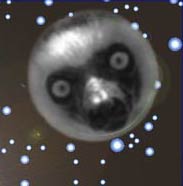
"Look at the moon,"
said Betty, "The man in the moon is a lemur tonight"
And so it was, or rather it appeared that way; and the more I
looked at the image, the more lemur-like the visage appeared.
Of course, I know, as do you, that the patterns on the moon can
be construed to look almost like anything if your have the time
and imagination or enough champagne.
I suddenly had an urge to
look at the stone I held in my hand. I took it out and turned
the flat side up so it was illuminated by the moonlight. I knew
I was only looking at an ordinary river rock, white with shades
of grey mottling rather like the moon itself. But something extraordinary
was beginning to happen. The stone seemed to take on a glow of
its own. And the patterns in the rock seemed to be rearranging
themselves like swirling clouds. As I watched, I simply could
not believe what I was seeing.
"There is a face appearing
in my stone," I said.
"And in mine," she
answered.
And the face in the stone
was the same as the face in the moon.
It was a Lemur. There was
no question about it.
And then it was gone.
Did we see it
Or did we not?
The Lemur knows
But answers not.
Go
to Part 3
Back to top of page
Story:
Part 1
The Spell of the Lemures
Catalog Index
Home
Page
|